FAIRFIELD — Becca Rogers found out she had cancer on a Wednesday.
She went to work Thursday.
For the 28-year-old Creekside Middle School teacher and Fairfield volleyball coach, staying home to contemplate a diagnosis she never imagined receiving didn’t seem like much of an option.
“What am I supposed to do? You want me to sit at home and just sit by myself and soak in this?” Rogers recalled thinking. “That’s just how I cope and it’s just how I am and how I was raised to be. You show up for what you are responsible for.”
Rogers kept showing up.
For her students. For her volleyball players. For her colleagues.
On Monday night, Sept. 14, they showed up for her.
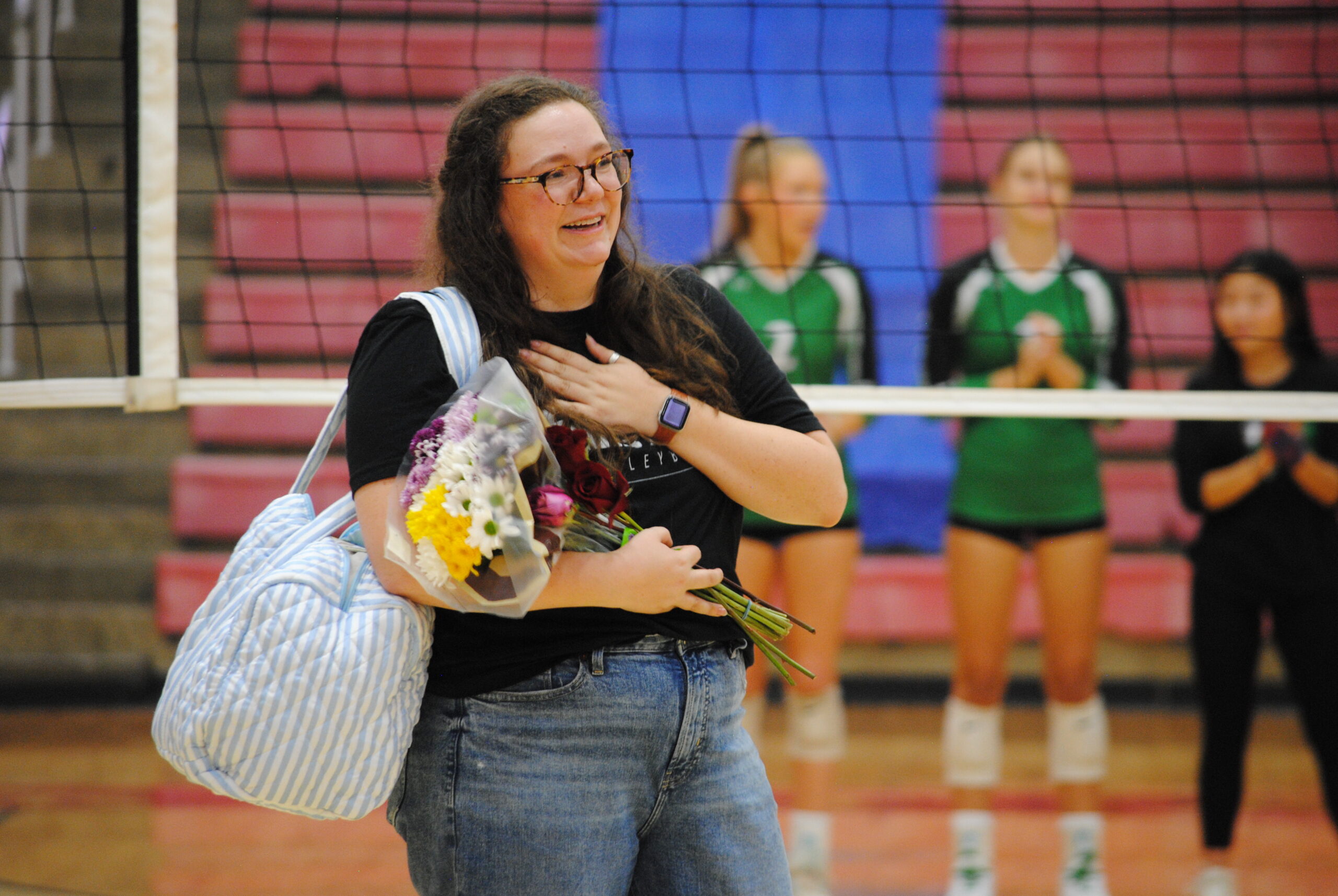
Rogers was recognized during Fairfield’s girls volleyball match against Badin as part of the annual Fairfield Leads the Fight event, which raises money and awareness for someone in the Fairfield community affected by cancer.
This year, that person was Rogers.
“It was such an honor,” she said. “A really crazy, crazy thing. I was not imagining that this would be a part of my story, but I’m really blessed with the community that has surrounded me since the diagnosis back in April.”
The event included raffle baskets, food and drinks, T-shirt sales and volleyball, but its significance to Rogers went beyond the fundraiser.
It represented the people who have helped carry her through one of the most unexpected stretches of her life.
Rogers’ journey began in February when what she initially thought might be a urinary tract infection became something much more concerning. She passed a large blood clot and sought medical attention.
“Thankfully, I listened to my body and I went to the doctor,” Rogers said. “I was like, ‘This is not a UTI. Tell me what’s going on.’”
A CT scan revealed a mass on her bladder. During a procedure over spring break, doctors discovered a 5-centimeter tumor.
Cancer.
The tumor was removed, and Rogers later learned the cancer was Stage 1 and had remained contained within the bladder. She underwent six weeks of immunotherapy during the summer.
A follow-up procedure in early August found no new tumor and no present cancer cells. Rogers moved into maintenance treatment, with shorter treatment cycles scheduled through the remainder of the year.
The encouraging medical news hasn’t completely eliminated the mental burden.
“You always wonder, like, ‘Oh gosh, if you feel sick, is it coming back again?’” Rogers said. “My peace of mind has had to be redefined.”
Cancer isn’t necessarily visible when Rogers walks into her classroom or volleyball gym. She said that can make it difficult to explain the weight that remains even when she looks and feels healthy.
“At a glance, you might not be able to see that it’s impacting me,” Rogers said. “But at the end of the day, it’s me, and I’m the one dealing with it day in and day out.”
She hasn’t dealt with it entirely alone.
Her family, church, colleagues, students and volleyball players have surrounded her. Monday night provided the most public example.
For someone who prides herself on independence, accepting that support has been another adjustment.
Cancer has forced Rogers to reconsider what strength looks like.
“The biggest lesson is that even though it is not comfortable for me, vulnerability is the best place to be,” Rogers said. “People want to care and want to come around and help in whatever way they can.
“I have permission to ask, and I have permission to say yes to all of the things. And that doesn’t make me incapable on my own. It just makes it that I can bear the weight with other people.”
The fight
Almost everything about Rogers made bladder cancer seem unlikely.
She was 27 when the symptoms began. She had no family history of the disease, didn’t smoke and lacked the traditional risk factors that might have made cancer an immediate concern.
Even after a CT scan revealed a mass on her bladder, Rogers’ urologist believed it was likely benign.
Then came the procedure during spring break.
Doctors found a 5-centimeter tumor.
“My doctor knew as soon as she saw it,” Rogers said.
The diagnosis was frightening, but the timing of the discovery proved critical. Rogers said the cancer was Stage 1 and contained within the bladder, allowing doctors to remove the tumor during the procedure.
“The cancer was seen and in the same procedure was entirely taken out,” Rogers said. “It was exactly where it needed to be to be able to have it just removed.”
That provided an answer to what was happening inside Rogers’ body.
It didn’t answer why.
Because of her age and the unusual circumstances surrounding the diagnosis, Rogers underwent genetic testing. She said the results did not reveal an underlying genetic condition.
That was welcome news but left her with another kind of uncertainty.
“We don’t know what caused this,” Rogers said. “We don’t know where this came from. I had no family history of any sort of cancer like this.”
For someone accustomed to solving problems and handling responsibilities herself, the lack of an explanation has been difficult to accept.
“So many things are uncontrollable, and yet our human minds want to cling to the control of like, ‘Oh, it could have been caused by this. It could have been caused by this,’” Rogers said. “And there is just no answer right now.”
Treatment became the next step.
Rogers underwent six weeks of immunotherapy after the school year ended. In early August, doctors performed another procedure.
This time, the news was what she had hoped to hear.
No new tumor.
No present cancer cells.
Rogers has since moved into maintenance treatment, with shorter cycles scheduled through the remainder of the year. Future scopes and scans will continue monitoring her.
The medical progress has been significant.
The psychological recovery isn’t as simple.
A clear scan doesn’t erase the memory of hearing the word “cancer.” A normal day doesn’t guarantee that a physical symptom won’t spark another question.
Someone can tell Rogers she looks great.
“But you always have to wonder,” Rogers said. “My peace of mind has had to be redefined.”
That has been one of the contradictions of Rogers’ experience.
Her illness and treatment haven’t always been visible to the people around her. She can teach a class, coach volleyball and go about her day while carrying something most people can’t see.
“Yes, I’m mentally just weighed down by something really, really hard and something weighty,” Rogers said. “I have a fantastic family, and I have a fantastic community, but at the end of the day, it’s like it’s me, and I’m the one dealing with it day in and day out.”
There are still treatments ahead. There will be more tests and more moments of uncertainty.
But the 5-centimeter tumor doctors found in the spring is gone.
And Rogers keeps moving forward.
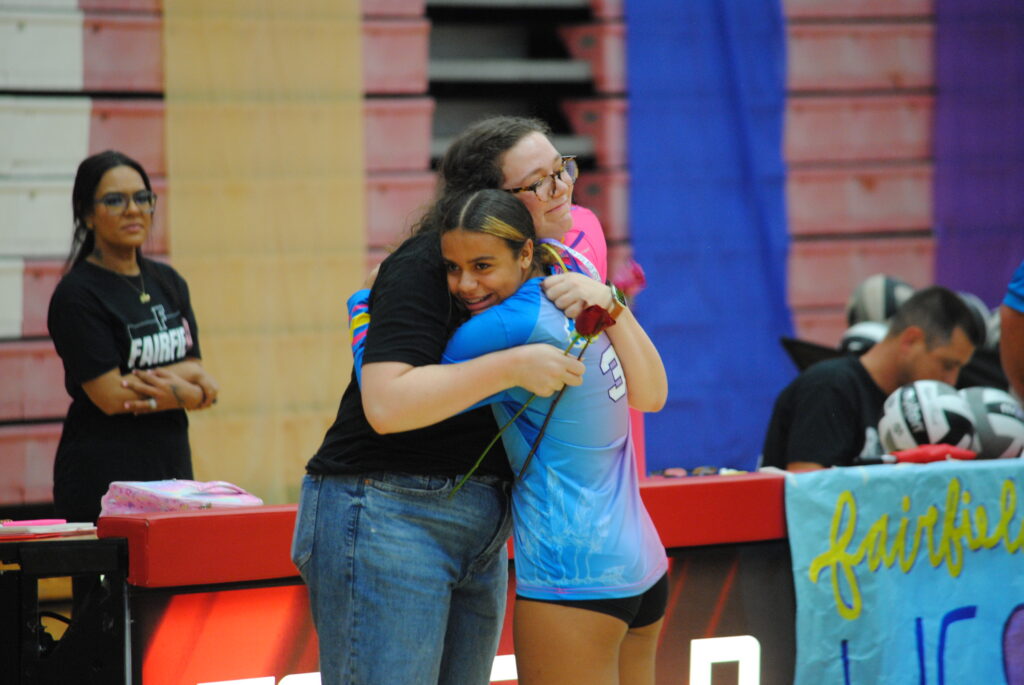
Her other team
Rogers spent years helping Fairfield volleyball players grow up.
Now those same players are helping their coach through something much bigger than volleyball.
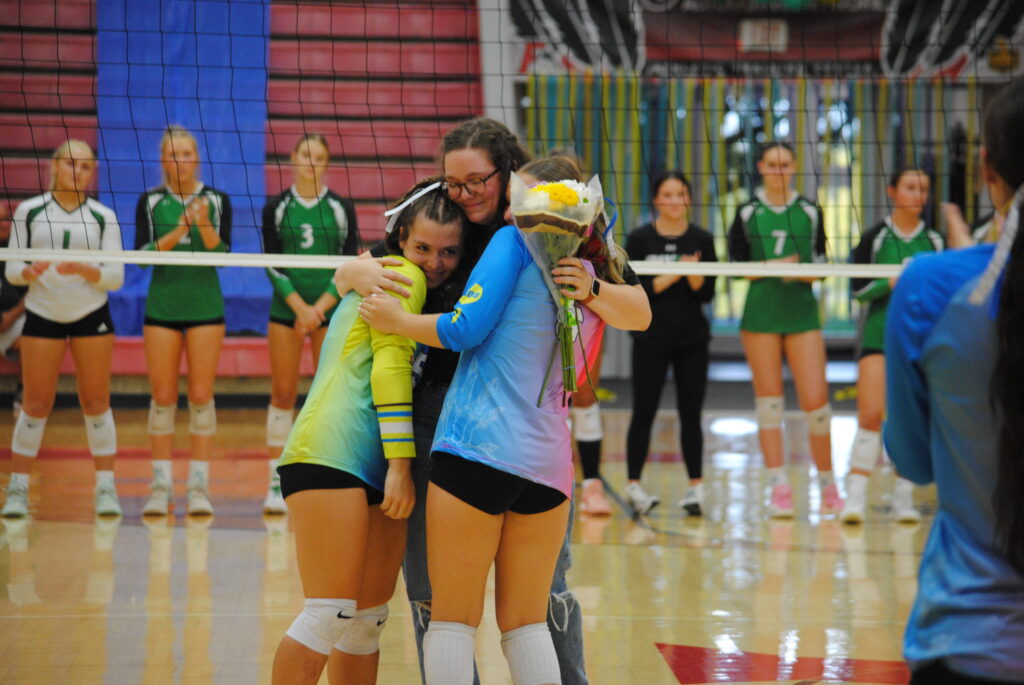
For Rogers, Fairfield’s Leads the Fight match against Badin represented a full-circle moment. Some of the players surrounding her in the gym were seventh- and eighth-graders when Rogers coached them at Creekside Middle School.
Now they’re high school volleyball players.
And they’re part of her support system.
“It’s really cool,” Rogers said. “I’ve got two girls from my group that are on the freshman team. I have two freshmen that are on the varsity team. I’ve got half of the JV that I’ve either coached this past year or years previous.”
The relationships trace back to a career Rogers knew early on she wanted.
A Bellbrook High School graduate, Rogers attended Miami University and studied language arts and social studies as part of the middle childhood education program.
She graduated in 2020, meaning her teaching career began amid the COVID-19 pandemic.
After student teaching in Hamilton, Rogers landed a long-term substitute position at Fairfield’s freshman building before eventually moving to Creekside.
She found her niche with middle school students.
“I’m one of the crazy people that just genuinely enjoy middle schoolers,” Rogers joked.
Rogers spent five years teaching social studies before budget-related staffing changes moved her back to language arts this school year.
The change meant learning a new subject, classroom and teaching team while navigating the aftermath of cancer treatment.
“It has contributed deeply to the mental load at the beginning of the school year,” Rogers said.
But the classroom also has provided something else.
Normalcy.
The morning after learning she had cancer, Rogers went to school. Her students didn’t know what had happened, although some later told her they sensed something was wrong.
Teaching gave Rogers somewhere to put her attention.
“It took my mind off what it needed to take off,” Rogers said. “It gives me a really good mental occupation throughout the day. And I can’t really imagine doing anything else.”
Volleyball provided another outlet.
Rogers remained involved with Fairfield’s program during the summer while undergoing immunotherapy, and many players had no idea what their coach was going through.
That changed when Rogers agreed to be honored by Fairfield Leads the Fight.
She knew her story would soon become public. Before players discovered it through social media or promotional material, Rogers wanted them to hear it directly from her.
She gathered them in groups — seventh-graders, eighth-graders and high school players — and told them all in one night.
“I was like, ‘Well, you guys saw me all the time and didn’t know that this was happening, and I’m OK, and I need you not to freak out when you see that this is happening in my honor,’” Rogers said.
There were tears.
Then hugs.
Then questions.
Are you OK?
Rogers assured them she was.
“Yes, this is scary,” Rogers told them. “Yes, this is hard, but I will be OK.”
The girls responded the way teammates do.
Some brought care packages. Others offered hugs. Many simply made sure their coach knew they were there.
They were there again Monday as Fairfield recognized Rogers during the match against Badin.
For years, Rogers’ role as a teacher and coach has been to show up for young people.
Cancer reversed those roles in a way she never expected.
“People want to care and want to come around and help in whatever way they can,” Rogers said. “I have permission to ask, and I have permission to say yes to all of the things.
“That doesn’t make me incapable on my own. It just makes it that I can bear the weight with other people.
“And I’m — now — perfectly fine with that.”