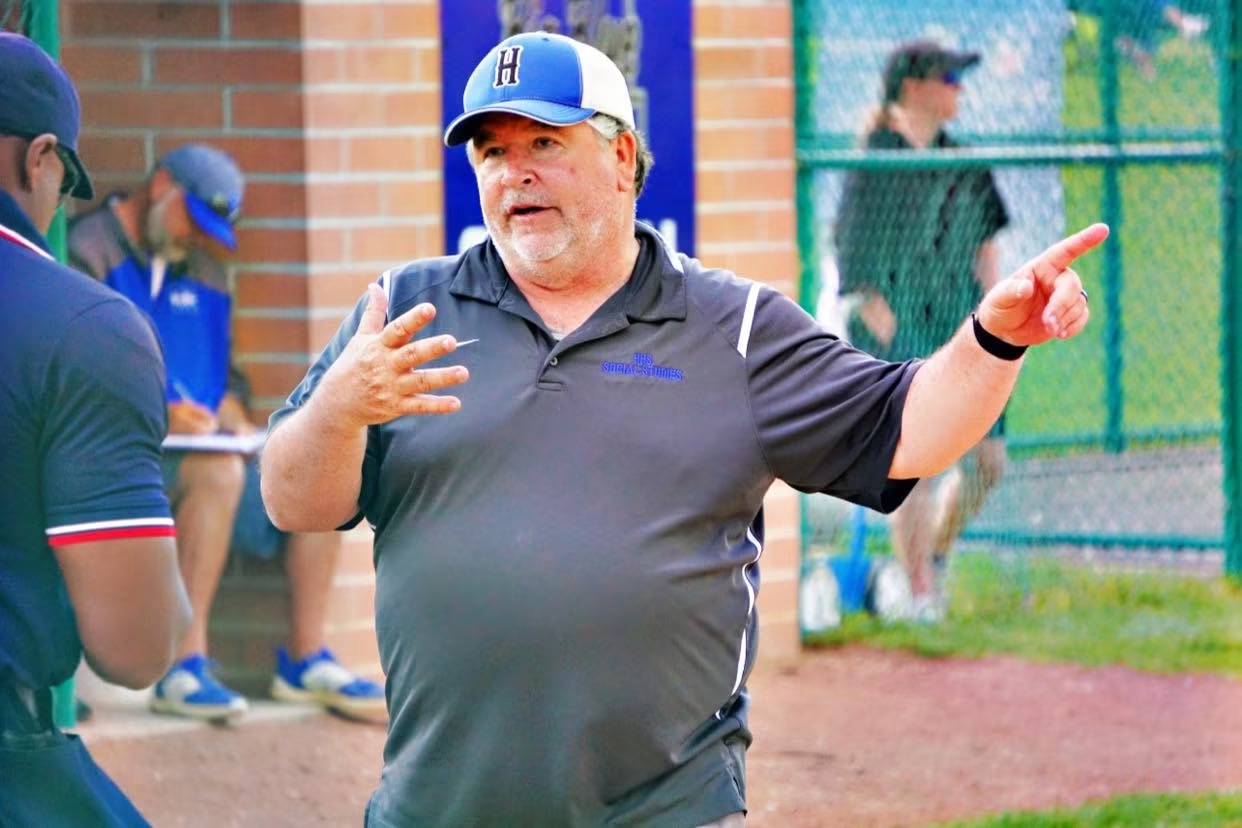
HAMILTON — Steve Heckman walked toward the Hamilton High School softball field without a mower to push, a line to drag or a list of jobs waiting for him.
That was the strange part.
The field had been part of his routine for more than three decades.
There was always something to fix. Grass to cut. Dirt to smooth. Weeds to pull. A tarp to move. A practice to organize. A game to manage. A player to encourage.
A program to protect.
This time, Heckman was not there to run a softball team.
He was there to look around — and talk about what happened on that very same field for the last 30-plus years.
“It was a little bit different today coming down, for sure,” Heckman said. “Usually there’s a lot of work involved — mowing and working on the field and just the general stuff.”
After 36 years with the Hamilton Big Blue softball program — including 34 seasons as head coach — Heckman has retired. He leaves with 474 career victories, three state Final Four appearances and five Greater Miami Conference Coach of the Year awards.
He also leaves behind something harder to measure.
Heckman built one of Hamilton’s most respected girls athletic programs. He taught social studies. He served as department chair, dean of students and National Honor Society adviser. He’s helped keep score at basketball games and football games. He’s watched generations of Big Blue athletes grow up, graduate and return with families of their own.
Softball was his sport. Hamilton became his place.
“It’s been an outlet for me,” Heckman said. “The connections you can make — I felt that it made me a better teacher and a better communicator.”
Heckman did not arrive at Hamilton with a grand plan to become one of the longest-tenured coaches in school history.
He was newly married. He was working in HVAC. He was looking for a teaching job. His wife, Rebecca, had ties to the area, and Hamilton had an opening.
He interviewed with Bud Bierly for a social studies position. During the conversation, Bierly asked whether Heckman knew anything about fastpitch softball.
Heckman did not pretend.
“No clue,” he said.
That was the beginning.
Heckman was hired for the 1990-91 school year and became the junior varsity softball coach. Dwayne Stacy was the varsity coach then and helped bring Heckman along. Heckman went to clinics. He studied the game. He learned.
Two years later, he was asked to take over the varsity program.
Larry Wood, Hamilton’s athletic director at the time, gave him a simple message.
“We just want some consistency,” Wood told him.
Heckman said he could provide that.
He had no idea how true that would become.
“I didn’t have any idea about this kind of thing,” Heckman said. “But I remember telling him at the time, ‘I can bring consistency.’”
He did.
Heckman stayed through changes in players, principals, athletic directors, facilities, rules and eras. He coached before every player had a phone. He coached through the rise of travel ball. He coached through changes in pitching distance, hitting instruction, strength training and the way high school sports evolved.
He coached through 2020, when the season was wiped out completely by the pandemic. Heckman counts that year because there was still a team to lead.
“We kept in touch with people,” he said. “It wasn’t softball, but we kept with the team and kept in touch with people, making sure they had what they needed. You never know in a situation like that.”
That mattered to Heckman because coaching, to him, was never just about lineups.
It was about standards.
He expected his players to represent Hamilton in the classroom, in the community and on the field. He wanted them to compete hard, respect the game and respect the school.
He wanted the program to be bigger than him.
“I always tried to do the right thing,” Heckman said. “I always tried to have something bigger than me. It’s the community. It’s the school. I always wanted us to be respectful.”
Hamilton softball became known for that.
Some years were better than others, he elaborated. Some teams had Division I talent. Some had to fight for every run and every out. But Heckman believed the Big Blue were rarely an easy day for anyone.
“This is a tough place to win,” Heckman said. “You’ve got to have a lot of things going right. But that was a very big pride point for us — to represent girls athletics in Hamilton. I felt we always did so.”
Heckman knew Hamilton was different from some of the suburban powers around it. He remembered driving by Mason’s athletic complex years ago one Sunday and seeing what seemed like hundreds of young athletes playing soccer, lacrosse, baseball, softball, you name it.
Hamilton did not always have that same built-in pipeline.
That made every win mean more.
“We can’t miss,” Heckman said. “We can’t get anybody hurt. But, man, we competed.
“We didn’t get people’s third pitcher let’s just say that.”
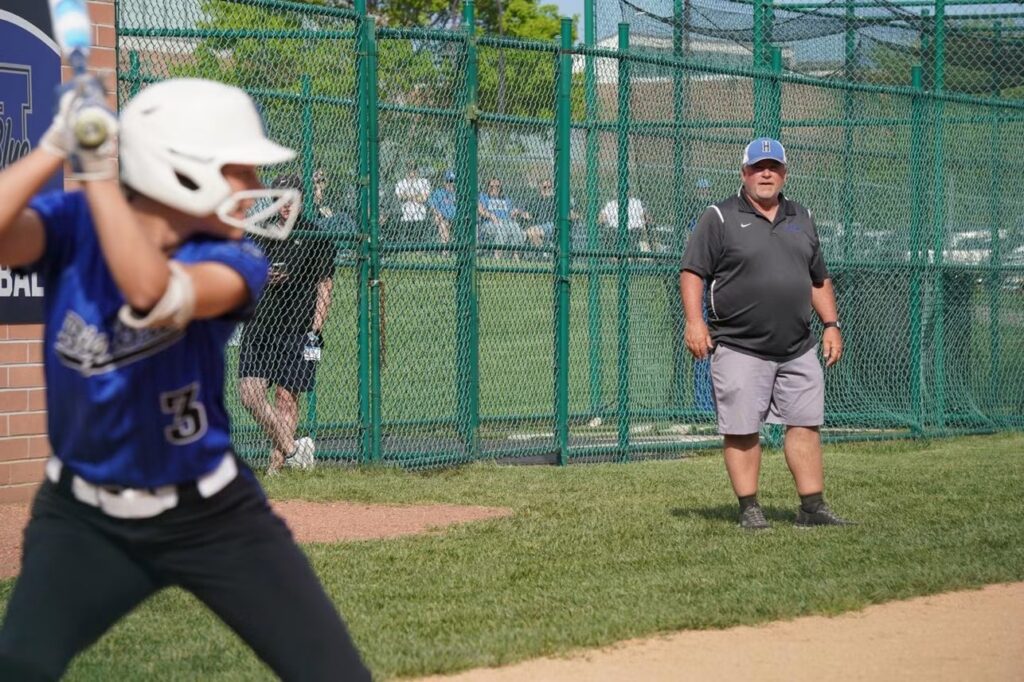
THE FINAL FOUR RUNS
The first state appearance came in 2001.
Heckman still remembers the bus ride.
Hamilton had a sendoff through town. The players rode past the city’s schools. Students came outside. A police escort led the way. Heckman’s son was in kindergarten at Fillmore Elementary, and the bus went past the school.
“It was really cool,” Heckman said. “We’re going down Main Street, and we’ve got the police escort going out.”
Then came one of those details that stays with a coach forever.
Someone on the bus asked if they had to stop for anything with a police escort.
Heckman said no.
Then he thought about it.
“Well, we’d stop for a funeral,” he said.
A few moments later, they saw one.
“We went right around them,” Heckman said. “I’m like, ‘Oh, man, I hope this isn’t a bad omen.’”
It was not.
Hamilton beat Whitehouse Anthony Wayne 5-1 in the Division I state semifinals and reached the state championship game. The Big Blue finished as state runner-up after falling to Youngstown Boardman.
Hamilton returned to the state tournament in 2002, losing 2-1 to Elyria in the state semifinals. Four years later, the Big Blue made it back again in 2006.
That third trip remains special to Heckman because it proved Hamilton had not simply caught one great class at the right time.
“We went in ’01 and ’02, but then we went again in ’06 with a completely different group of kids,” Heckman said. “Not one kid was the same. I think that’s pretty special.”
Heckman understood how difficult it was to reach the state tournament once.
“You can run into lightning,” he said. “You can just have a tremendous group. It takes a lot of skill and a lot of luck.”
Hamilton did it with more than one group.
That was the program.
Heckman coached tremendous players. He mentioned Katie Halcomb, DJ DeLong, Jennifer McKee and Emili Schappacher among the many who left a mark.
Halcomb was a dominant pitcher when the distance was still 40 feet. DeLong was such a strong infielder that Heckman could use her in creative ways. McKee was another standout. Schappacher became one of the top players in Ohio near the end of Heckman’s tenure.
Heckman said Schappacher’s all-around ability put her in rare company.
“She was Division I all-Ohio,” Heckman said. “There’s three from this region that are first team. Three. It’s not like there’s 10.”
Schappacher was also named Cincinnati Enquirer Division I player of the year.
“That’s pretty special,” Heckman said.
The game gradually changed around Heckman.
Early in his career, softball was built around pitching, defense and small ball. Runs were hard to find.
“It used to be 1-0, 2-1,” Heckman said. “You couldn’t just sit there and wait to mash because it wasn’t going to happen.”
Now, hitters are stronger. Swing instruction has improved. Players spend more time training. Home runs became more common.
Heckman said Hamilton hit 30 home runs one season and would be in the mid-20s the next.
“That’s a credit to the hitters,” Heckman said. “People are spending a heck of a lot more time on hitting.”
That changed how games felt to Heckman.
“You get down five runs now, and you’re OK,” he said. “Same thing, you have a five-run lead, and it’s like, ‘We’ve got to keep going.’ It can change in a minute.”
Some things did not change.
Fairfield was still Fairfield.
Heckman called the Indians Hamilton’s biggest rival. He respected longtime Fairfield coach Brenda Stieger — who also recently retired — and the battles between the two programs. He said Stieger was one of the first people to reach out after his retirement became public.
The GMC was loaded with veteran softball coaches for much of Heckman’s career. He mentioned Stieger, Mason’s Liann Muff, Oak Hills’ Jackie Cornelius, the Castners, along with many others.
“That’s insane,” Heckman said. “Just the knowledge that they all had — you tend to pick up stuff from every one of them.”
There were competitive all-league meetings. There were tense games. There were hard feelings on some days.
But there was respect — which is what Heckman wanted Hamilton softball to have.
Respect.
‘THE EVERYDAY’
Heckman will miss the games.
He will miss the celebrations.
He will miss beating Fairfield and watching Hamilton’s pride spill out all onto the field.
“But I’m going to miss the everyday,” Heckman said. “This was part of what I did.”
The work started in October. Open fields. Hitting. Conditioning. Weights. Then came the season. Then came late May, if things went well. Then came more field work.
Dragging dirt. Pulling weeds. Making sure the place looked right. Rinse and repeat.
That work was not separate from coaching. It was part of it.
Heckman believed taking care of the field showed players the program mattered. It showed the community the program mattered. He said he hopes it shows the next coach what the standard should be.
He does not know what Hamilton will do with the field name someday. Friends have joked about it. Others have mentioned it.
Heckman does not push for that.
He is more concerned with what happens on it.
“I just want the same respect for the game, same respect for the kids,” Heckman said. “I want somebody that’s going to love it. Somebody that’s going to take care of it and do the right thing.”
He knows high school sports are harder now. There are more pressures, more outside influences and more complications.
But he still believes the work is worth it.
“We owe it to the kids to do the very best we can,” Heckman said.
That was always the center of his approach.
Heckman did not claim to be perfect. He said he hated telling players they were not starting or not hitting. He wanted to play everyone every inning, even when he knew that was not possible.
“I hated being the bad guy,” he said, humbly.
But he believed players could earn opportunities. They could earn their way on the field and, sometimes, earn their way off it.
He also believed coaches could be demanding without losing empathy.
That became one of his strongest messages.
“Life is hard. Sports are hard,” Heckman said. “Don’t make it any harder.”
He wanted players to understand they were not alone. Wins belonged to everyone. Losses did too. The dugout was supposed to be a place where people had each other’s backs.
“You win together, you lose together,” Heckman said. “Be a part of it. Have those feelings and know you’re not alone.”
That philosophy came from more than softball.
Heckman spent almost his entire professional life at Hamilton. He felt respected as a teacher. He raised his children around the school. Both graduated from Hamilton. His daughter played for him. His son played baseball.
He worked with athletic directors who supported him. He mentioned all the people who treated him well.
“What do you need?” Heckman said. “That was always the thing.”
He also worked alongside coaches who helped shape the culture of Big Blue athletics.
“I never felt like we were less than,” Heckman said. “It was never, ‘We’ve got the gym, you guys go find somewhere else.’ It was, ‘How are we going to do this?’”
That is part of why he stayed.
Heckman had chances to think about what life might look like somewhere else. But Hamilton kept giving him reasons to remain.
“I don’t have anything bad to say,” he said. “I always felt respected.”
Heckman’s retirement has brought phone calls, messages and memories. Former players have reached out. Colleagues have thanked him. The school board honored him.
The words have meant more than he expected.
“That’s not why I did it,” Heckman said. “But it does feel good.”
Heckman said he hopes he made players better.
Not just better hitters. Not just better fielders. Not just better pitchers.
Better people.
“I hope so,” he said.
That is the legacy he leaves.
The 474 wins will remain in the record book. The Final Four trips will stay in Hamilton softball history. The GMC awards will always be part of his résumé.
But Heckman’s real mark is in the players who learned how to compete, the students who sat in his classroom, the coaches who respected him, the families who trusted him and the community that saw him keep showing up.
Year after year.
Season after season.
Day after day.
Heckman came to Hamilton looking for a job. He became part of the town’s athletic fabric.
The next time he walks to the softball field, he might not have to mow it. He might not have to drag it. He might not have to make out a lineup card.
“It’s hard to believe … done,” Heckman said with a slight pause. “Just like that … over.”
But part of him will still remain one of Hamilton’s Finest.